
Knowledge - 06
Is tobacco grown in Switzerland?
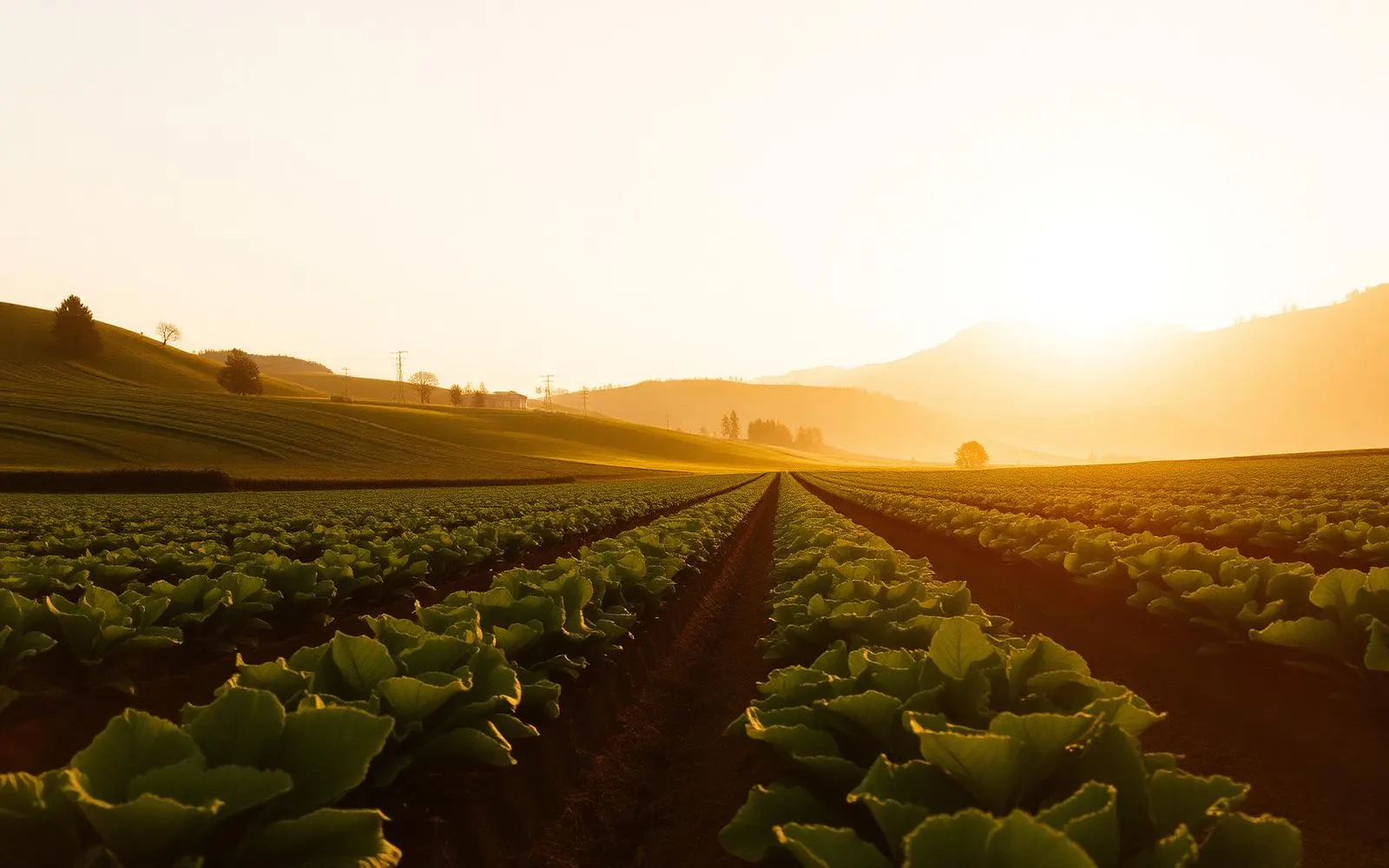
Yes. Tobacco has been grown in Switzerland since 1680. Today around 140 growing families cultivate about 700 tonnes of tobacco per year on roughly 470 hectares - across nine cantons, some 90 % of it on the Broye plain. This page explains where the tobacco grows, which varieties are used, how it is processed and how a Swiss tobacco year unfolds.
Definition
Tobacco cultivation in Switzerland encompasses the entire plant year: sowing in February, planting in May, care until maturity, harvesting from July, drying in late summer and autumn, delivery to the growers' association in winter. One hectare of tobacco requires around 1500 hours of labour - about ten times more than one hectare of wheat.
01
Swiss Tobacco Cultivation in Numbers
The numbers are small, but stable.
Around 140 farms cultivate tobacco in Switzerland today, organised within the SwissTabac growers' association. The cultivated area has been around 470 hectares for years - a fraction of the area in the 1960s, when over 5000 hectares of tobacco were cultivated.
The annual harvest quantity ranges between around 700 tonnes of raw tobacco. Approximately two-thirds of this is traded as Burley, one-third as Virginia. Switzerland's self-sufficiency in its own tobacco is less than one percent - which makes Swiss tobacco not a question of quantity, but of character.
Geographical distribution: 75 percent of the cultivated area is in the Broye Valley (Vaud and Fribourg). Other relevant cultivation areas are Aargau, Thurgau, St. Gallen, Tessin and parts of Central Switzerland. Heimat exclusively sources tobacco from this Swiss growers' circle.
02
February to April: The Seedbed
Tobacco begins not in the field, but in the greenhouse.
In late February or early March, the seeds are sown in shallow trays in a heated greenhouse. Tobacco seeds are tiny - 1 gram contains around 10 000 grains. In a few square metres, seedlings for several hectares of field area are grown.
In the first few weeks, the seedlings require consistently warm temperatures of around 22 degrees and uniform moisture. Neglecting the seedbed means no seedlings in May and thus no tobacco year. This phase is the most technically demanding because the grower must care for hundreds of small plants simultaneously.
From April, the young plants are hardened off - outdoors during the day, back indoors at night. This preparation for the outdoor climate determines how robustly the plants will survive the first few weeks in the field.
03
May: Planting Out in the Field
Once the Ice Saints have passed, the seedlings are planted.
Mid to late May - typically after the Ice Saints - the approximately 25 centimetre tall seedlings are planted in the field. Planting distance: around 60 centimetres between plants, 90 centimetres between rows. Between 18,000 and 22,000 plants are set per hectare.
Planting is partly done by machine, partly by hand - depending on the size of the farm. In any case, it remains hand and knee work, because each plant is watered after setting to ensure establishment.
In the first ten days, it is determined what percentage of the seedlings actually take root. With good weather, over 95 percent; with drought or late frost, sometimes only 60 percent - then replanting must be organized.
04
June to July: Care and Topping
Hoeing, checking, topping - summer determines the quality.
The plants grow rapidly. In June, the fields are hoed to remove weeds and keep the soil structure open. Pest controls are conducted weekly - the main risks are aphids, cutworms, and in wet years, downy mildew.
In July, the plants reach their full height: Burley up to 2.20 meters, Virginia more compact at around 1.60 meters. The crucial intervention at this phase is topping - the flower head is nipped off as soon as the first buds appear. The plant stops its reproductive energy and diverts it to the leaves.
After topping, suckers emerge from the leaf axils - these are removed by hand over several weeks. Neglecting this leads to a loss of leaf mass and depth of flavour.
One hectare of tobacco requires ten times more labour hours than one hectare of wheat. Topping and suckering are largely done by hand.
05
July to September: The Harvest
Tobacco is not harvested in one go, but leaf stage by leaf stage.
The lowest leaves ripen first. As soon as they reach their characteristic yellowish-green colour, they are picked by hand - typically at the end of July. This first harvest is called sand leaves.
Over six to eight weeks, the harvest progresses upwards in stages. 18 to 22 leaves are harvested per plant, in three to five passes. The uppermost leaves, known as tip leaves, are the thickest, darkest, and contain the most aroma components.
Burley is harvested whole (entire plants) or as single leaves - depending on the drying method. Virginia is always harvested as single leaves, because heat drying requires sorted leaf stages.
06
August to November: Drying in the Shed
What has been harvested goes directly into the drying barns.
Burley is hung in open tobacco barns - the characteristic wooden sheds with ventilation slits that shape the landscape in the Broye Valley. The leaves dry for four to eight weeks, undergoing spontaneous micro-fermentation and losing around 80 percent of their water.
Virginia is flue-cured in closed drying chambers. Over three to six days, the temperature gradually rises to up to 75 degrees. This process fixes the natural plant sugars.
Anyone driving through the Broye Valley in late summer will see the sheds fully hung - a landscape that has barely changed since the 19th century.
07
Winter: Delivery and Settlement
In winter, the tobacco is bundled, graded, and delivered to the growers' association.
From November, growers bundle the dried leaves into packages - traditionally around 25 kilograms. Each package is classified by variety, leaf stage, and quality.
Delivery to the SwissTabac growers' association takes place between December and March. There, grading masters assess the quality, which determines the payout price. Swiss tobacco is generally compensated based on quality, not just weight.
Only then does the tobacco go into the fermentation warehouses - for Heimat, to Payerne, where it rests for at least 18 months before being processed further. The next seedbed is already being created at this time.
Frequent Questions
Swiss Tobacco Cultivation in Detail
Yes. Tobacco has been grown in Switzerland since 1680. Today around 140 growing families produce about 700 tonnes of tobacco a year on roughly 470 hectares across nine cantons; about 90 % of the area lies on the Broye plain.
Around 140 farms, organised within the SwissTabac growers' association. The number has been relatively stable for about ten years, but was significantly higher in the past (over 4000 in the 1960s).
About 470 hectares, three-quarters of which are in the Broye Valley in the cantons of Vaud and Fribourg. Other cultivation areas include Aargau, Thurgau, St. Gallen and Tessin.
Between around 700 tonnes of raw tobacco annually. This corresponds to less than one percent of Swiss tobacco consumption - the rest is imported.
From late July to mid-September, in several passes, leaf stage by leaf stage. 18 to 22 leaves are harvested per plant in 3 to 5 harvest cycles.
Around 1500 hours of labour, about ten times that of one hectare of wheat. Planting out, hoeing, topping, suckering, and harvesting are largely manual work.
Delivery takes place via the SwissTabac growers' association. Buyers are the few Swiss manufacturers and manufactories, including Heimat. Heimat is the only brand that exclusively processes Swiss tobacco.
To a small extent, yes. The majority of Swiss tobacco production follows IP-Suisse guidelines (integrated production) with reduced pesticide use.
Vertiefung
Im Journal weiterlesen
Read on