
N°05 · Journal
From field to manufactory
A day with our growers and processors - what really happens between harvest and blend.
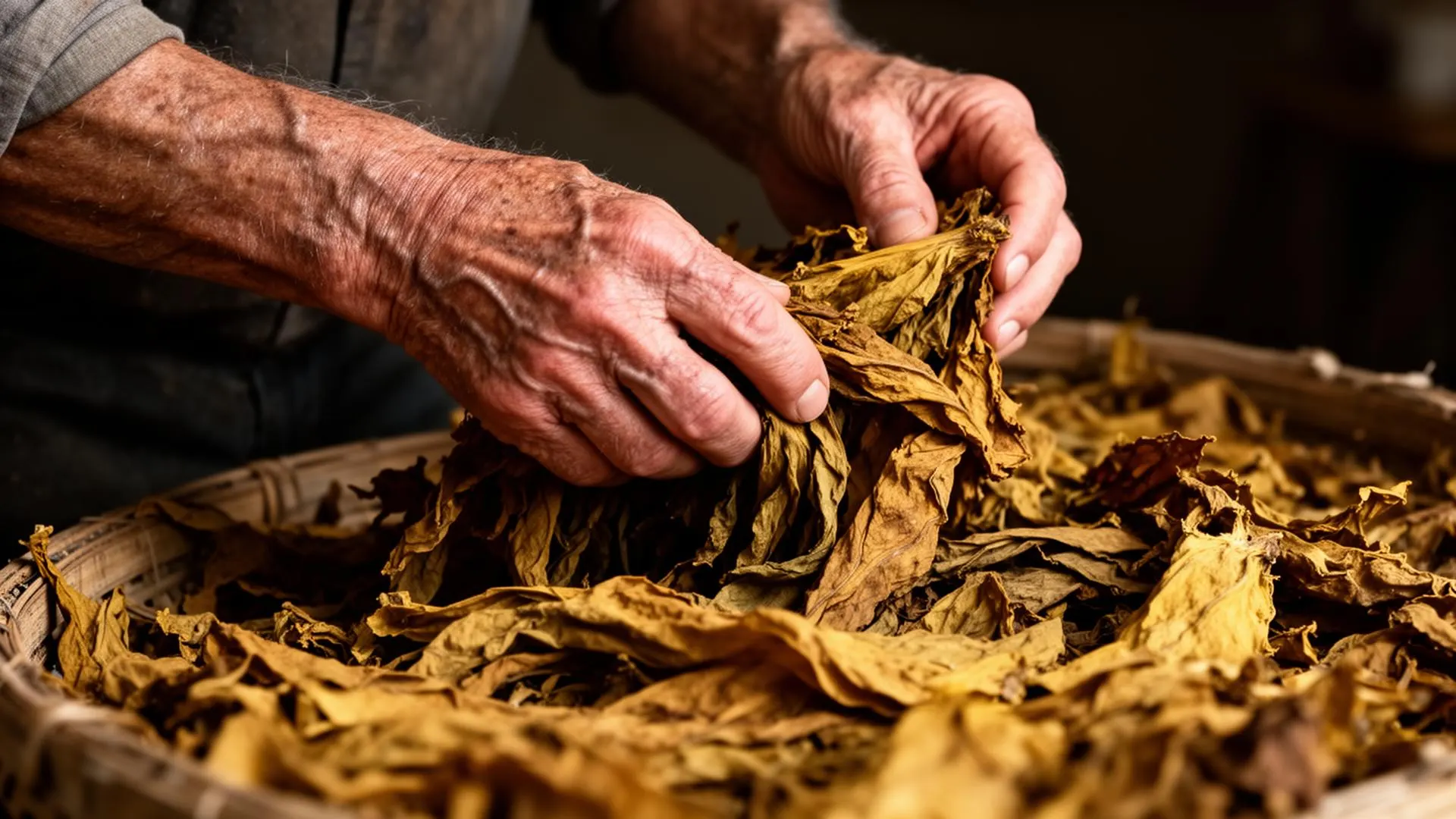
It is six in the morning, somewhere between Payerne and Estavayer. The sun still lies flat over the fields, the soil is cool. Markus, our oldest growing partner, walks down a row, testing leaves between thumb and forefinger. Today we harvest - but not everything. Only the leaves that are ripe today.
1. Priming, not stalk-cut
Our growers work almost exclusively by priming: over three to five weeks, only the leaves that have reached their optimum ripeness are picked per plant. That is more demanding than the American stalk-cut, where the whole plant is felled at once. But it is the only method by which every leaf reaches its own optimum.
2. The curing barn
Within hours the leaves hang in the open barn. Burley is air-cured - no fire, no smoke, only drawing wind and the temperature of Swiss late summer. Over 6 to 8 weeks the leaves shift from pale green to warm tobacco gold, then chestnut brown.
3. Conditioning
Dry leaf is fragile. Before further processing we bring it back to 12-14 % residual moisture in our conditioning chamber - enough to sort and stack without breaking.
4. First sort: by position
Each leaf is assigned to a stalk position:
- Lugs (lower): mild, light, ideal for blend balance.
- Cutters / leaf (middle): the core of any blend, round, aromatic.
- Tips (upper): intense, spicy, nicotine-rich.
5. Fermentation
The sorted leaves go into stacks - for us between 12 and 36 months. What happens there is described in why fermentation matters more than technique.
6. Stripping
The midrib burns differently than the lamina, tastes different and disturbs the mouthfeel. It is removed by hand or mechanically - for us only after fermentation, so the leaf stays supple.
7. Second sort: by quality
Now the eye decides: colour, texture, tears, spots. Only about 60 to 70 percent of a stack reaches manufactory grade. The rest is used elsewhere, just not in our signature blends.
8. The blend
Here tobacco moves from raw material to product. Different varieties, positions and vintages are brought together in precise proportions. A good blend doesn't taste of its components - it tastes of something new that they create together.
9. Resting the blend
Finished blends rest again - usually 3 to 6 months - before they are packed. The aromas have to get used to each other.
A good blend is like a good marriage: at the start you notice the quirks, in the end only the harmony.
What remains in the end
From the cut in the field to the first filled tin, at least 18 - often 36 - months pass in our manufactory. That is uneconomical by industrial standards. And the only way to show Swiss tobacco as it is.