
N°01 · Journal
What makes good tobacco?
A small school of taste - and why the answer doesn't live in the lab.
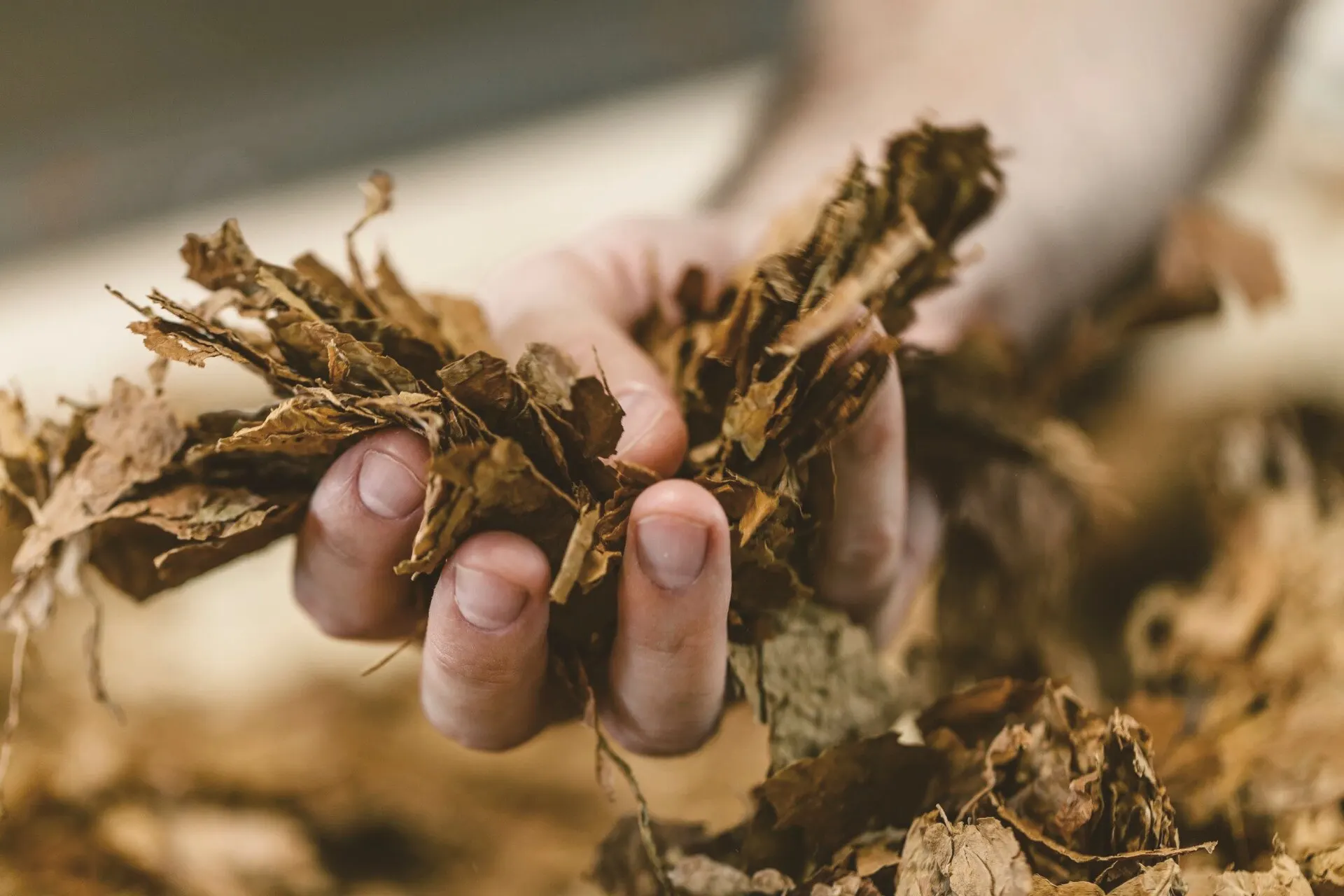
The question of what makes good tobacco is asked in our manufactory almost daily - by collectors, by chefs, sometimes by farmers testing their first own harvest. There is no short answer. But there is an honest one.
Good tobacco comes from the interplay of four things: soil, variety, time and hand. Take one of them away and no technique can hide the lack. Least of all marketing.
1. The soil speaks first
What later tastes as round soft sweetness, as a nutty finish or as mineral freshness begins below the surface. The soil gives the leaf its skeleton - potassium for combustion, magnesium for the green, nitrogen for the strength. Too much nitrogen makes tobacco loud and ammoniacal. Too little leaves it bland.
In the Swiss Broye, the valley between Vaud and Fribourg, loam soils sit on molasse - a mix that stores water and drains at the same time. Precisely what Burley loves.
2. The variety must fit the place
There is no "best" tobacco variety, only the right one for a given place. Anyone growing Virginia in a region of short summers harvests sugar-poor, pale leaves. Anyone growing Burley on dry sandy soil ends up with straw instead of aroma.
- Burley - air-cured, savoury, slightly nutty, low sugar.
- Virginia - sun- or flue-cured, light, sweet, high sugar.
- Maryland - mild, burns cleanly, traditional for Swiss Stumpen.
3. Time is the most expensive ingredient
Industrially processed tobacco is often "fermented" in a few weeks - with temperature, pressure and additives. Real fermentation, however, needs months, sometimes years. In that time microorganisms break down starch, protein and chlorophyll. What remains is the essence of the leaf.
A tobacco that wasn't allowed to rest tastes like a wine opened too early - loud, angular, unfinished.
4. The hand decides last
Every single step from picking to blend can be delegated - or deliberately shaped. Sorting leaf by leaf, turning the fermentation stacks daily, choosing the right moment for the blend - you taste the result. And above all: others taste it too.
How to recognise good tobacco
Three simple tests we recommend in the manufactory:
- Dry scent: good tobacco smells complex - hay, dried fruit, perhaps cocoa, never sharp or chemical.
- Combustion: the ash should be light grey to white and fall in pieces when tapped. Black, crumbling ash points to fertiliser residues.
- Finish: after the last draw the flavour ideally lingers 30 to 60 seconds - round, without bitterness.
And Swiss tobacco?
Swiss tobacco is never the loudest in a blend. But it brings a quality that has become rare: clarity. The cool climate, the long air-curing in open barns, the small grower operations - all that gives a leaf that has nothing to hide. Anyone who has tasted Swiss tobacco pure once doesn't forget that straight, almost modest character.
Read further: why fermentation matters more than technique · Broye - the heart of Swiss tobacco.