
N°07 · Journal
Burley from Switzerland - a variety with character
Europe's northernmost serious Burley region - and what that latitude means in the glass.
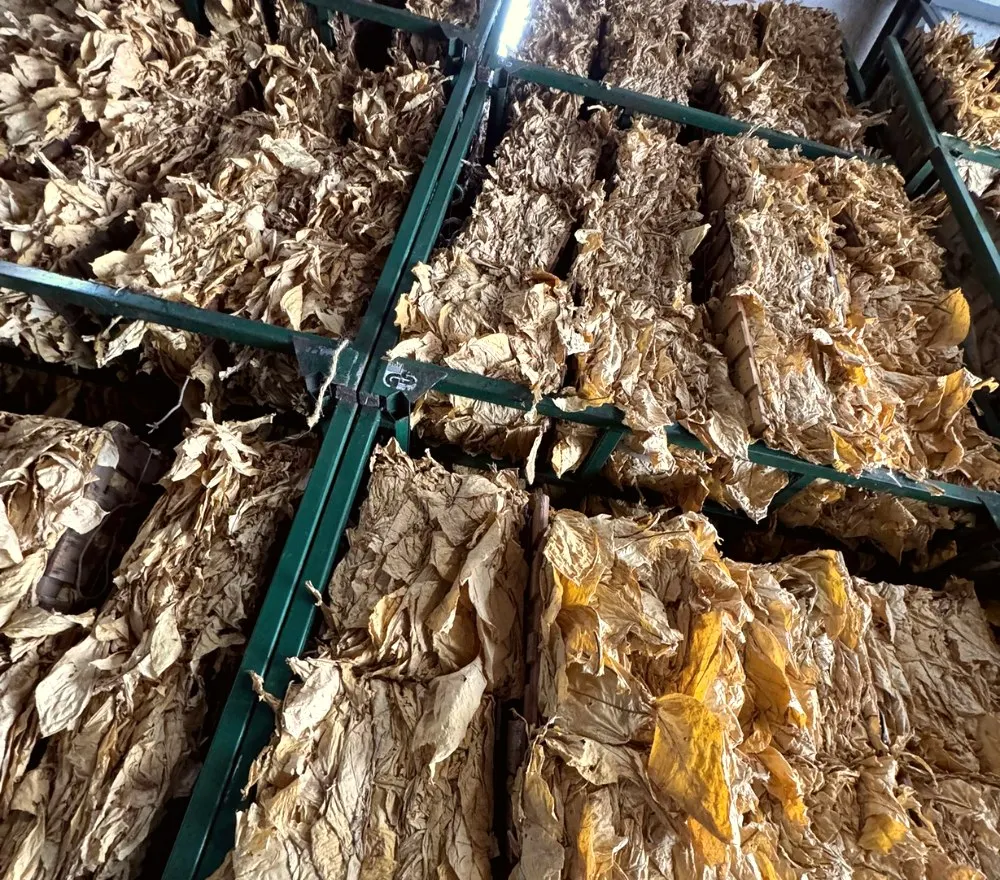
Burley is the world's second-most cultivated tobacco variety after Virginia - and at the same time the most underrated. It is the calm mid-voice of every good blend: not sweet like Virginia, not spicy like Oriental, but earthy, nutty, full-bodied. Swiss Burley plays that role with its own clear accent.
What Burley actually is
Burley was discovered in 1864 in Ohio - a spontaneous, chlorophyll-poor mutation of the white Burley plant. Its hallmarks:
- light, thin leaf, pale green to cream-coloured
- air-cured, no fire, no smoke
- very low residual sugar (typically < 1 %)
- high absorbency for casings and aromas
- nutty, earthy base with a hint of cocoa
Europe's northernmost serious Burley region
With fields in the Broye at around 46-47° latitude, Switzerland sits at the outer climatic edge of Burley cultivation. The growing season is markedly shorter than in Kentucky, North Carolina or southern Italy. That has three consequences:
- Lower tonnage per hectare. Where 2,500 kg/ha is standard in Kentucky, Swiss growers often harvest 1,500-1,800 kg/ha. Less leaf - but more concentrated.
- Lower nicotine. Typically 1.8-2.8 % versus 3.0-4.5 % in Kentucky. The result is a softer, less aggressive smoke.
- More aromatic depth. Cool nights preserve volatile aromas that tropical heat would burn off.
Sensory: a comparison
Place Swiss Burley next to a classic Kentucky Burley and the difference is immediate:
- Kentucky Burley: wood, leather, toasted bread, a slight bite in the throat.
- Swiss Burley: walnut, dried hay, caramel, a hint of plum, a soft mid-palate.
Swiss Burley is not a "mini Kentucky". It is its own reading of the variety - cooler, more patient, less loud.
How we use Burley
In our blends Swiss Burley is the structural base. It carries the body and what tobacco connoisseurs call mouthfeel - that pleasantly full sensation without sharpness. On its backbone, other components - Virginia for sweetness, Oriental for spice, a trace of dark Cavendish for depth - can do their work without dominating.
Cultivation in detail
Swiss Burley is sown into trays in April, planted out in mid-May and harvested from late August onward in several priming passes. Air-curing in open barns lasts 6 to 8 weeks. Then comes fermentation - for us at least 18 months. See our piece on why fermentation matters more than technique.
Why Swiss Burley still matters
In an industry dominated 90 % by a handful of growing regions, a small, independent northern European Burley is more than a niche. It is insurance against flavour monoculture. And for connoisseurs it is a chance to taste a variety in its quietest variation.