
Knowledge - 12
Sullana. Swiss tobacco with Peremochez Orient from Swiss soil.
Sullana is one of the oldest Swiss cigarette brands, founded in 1916. What makes today's blend special is not just the Orient component - but the fact that this Oriental tobacco, a variety called Peremochez, is grown exclusively for Sullana by a Swiss tobacco farmer in the region. This page explains the brand, the blend and why Peremochez grown in Switzerland deserves its own chapter in Swiss tobacco.
Definition
Sullana is a Swiss cigarette brand with roots in 1910s Zurich. Today's blend combines Swiss Burley and Virginia with the Oriental variety Peremochez. Unlike classic Oriental tobacco from the eastern Mediterranean, the Peremochez used for Sullana is grown and sun-cured in Switzerland - a Swiss tobacco specialty that exists nowhere else in this form.
01
From Cigarettenfabrik Union to the new Sullana
Sullana is not an invented heritage brand. It has nearly a century of Swiss industrial history, running between Zurich, Wetzikon and a brief shutdown - before its current revival.
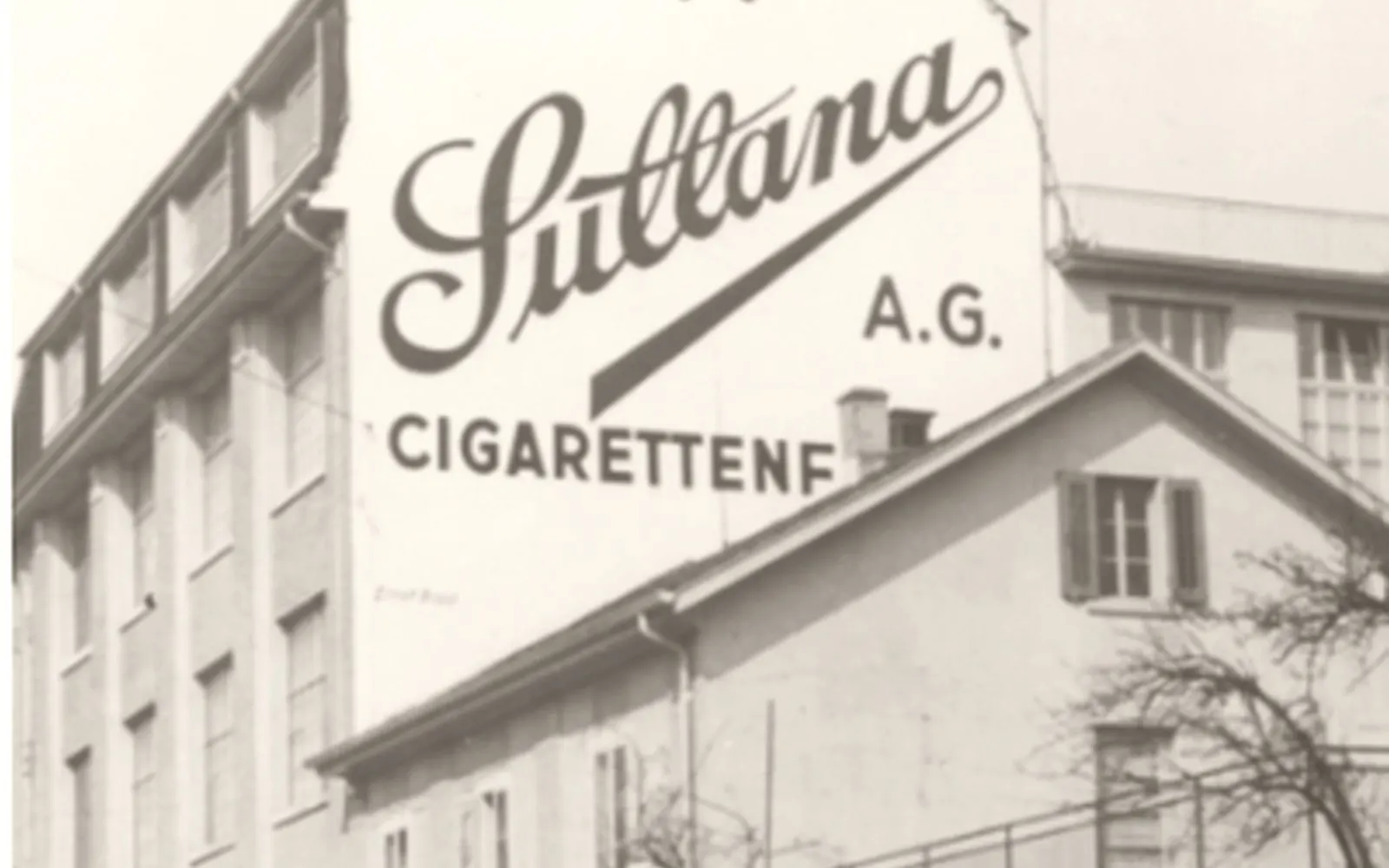
In 1916, Feiwel Beer - known as Philipp - founded the Cigarettenfabrik Union on Badenerstrasse in Zurich. Its range featured brands with orientally inflected names like Hera, Péra, Apollon, Stamboul and Byzanz - reflecting an era when Oriental tobacco was, in Europe, the very idea of a fine cigarette. In the 1920s the factory moved to Zurich's Sihlquai, where it would stay for decades.
During this period Sullana first appeared as one of several varieties from the Beer factory. It became so popular that the variety turned into a brand name: in 1939, when Beer & Cie. was converted into a stock company, the Sullana A.G. was founded. From the 1930s to the 1950s Sullana confidently advertised itself as the best-selling 1-franc cigarette in Switzerland. The small manufactory on Sihlquai exported around the world - with the promise Cigarettes Orientales, meaning cigarettes with Oriental tobacco, at the heart of the brand.
In 1967 Sullana moved to Wetzikon. The factory was later acquired by the Dutch Rothmans group, which used it to make small runs of brands like Peter Stuyvesant, Dunhill, Cartier and Vogue. Sullana itself became a factory rather than a cigarette: the in-house brands Palette, Effendi, Club and eventually Sullana itself disappeared from the shelves. In 1997 the Wetzikon site was finally closed - by that point Sullana as a brand was already history.
Today's revival does not pick up the last industrial years but the original character of the Sihlquai era: a Swiss brand with Oriental tobacco at its core - only more consistent, because the Oriental tobacco itself now comes from Swiss soil.
Sullana was already working with Oriental tobacco in 1916. Today that Orient grows in Switzerland.
02
The blend: Swiss Burley, Virginia and Peremochez
The new Sullana blend is a three-varietal composition with a clear division of labour. Each varietal contributes something the others cannot.
The base is Swiss Burley. Burley is air-cured, ageing in open sheds over several weeks and developing a nutty, slightly earthy aroma profile with substantial body. In Sullana it provides structure, depth and the carrying substance of the smoke - it is what lingers on the palate.
The second component is Swiss Virginia. Unlike Burley, Virginia is flue-cured and therefore retains a high residual sugar content in the leaf. This yields a finer, slightly sweet burn behaviour that brightens the Burley and carries the blend longer on the palate. Both Swiss varietals are naturally fermented for at least 18 months in Payerne before they enter the blend.
The third and defining component is Peremochez - an Oriental tobacco that does not come from Turkey, Greece or Bulgaria but is grown in Switzerland. Exclusively for Sullana. This varietal changes the character of the mix: a solid Swiss tobacco becomes a Swiss-Orient blend with an independent aroma profile.
Burley gives body, Virginia brightness, Peremochez spice. Three varietals, one Swiss signature.
03
Peremochez - Swiss Orient
Peremochez is what really sets Sullana apart. An Eastern-European Oriental tobacco variety grown in Switzerland - by a regional tobacco farmer, exclusively for this blend.
Botanically Peremochez belongs to the small to medium-leafed aromatic tobacco varieties traditionally cultivated in the eastern Mediterranean and Eastern European growing regions. It is characterised by a high content of essential oils, a relatively low nicotine level and a dense, oil-rich leaf. European seed catalogues list Peremochez as a late-ripening varietal with pronounced aromatic character.
That this varietal grows in Switzerland is anything but obvious. Oriental varieties are climatically demanding: they need sun, warmth and lean soils to develop their typical aromatics. Cultivation for Sullana takes place at a tobacco farmer in the region - in comparatively small quantities, using traditional sun-curing instead of the air- or flue-curing normally used for Swiss tobacco. The harvested leaves are strung up and dried in the open sun until sugars, resins and essential oils are fixed in the leaf.
This Swiss provenance is a rarity in the international tobacco market. Oriental tobacco is usually imported from its classical countries of origin and travels tens of thousands of kilometres before entering a blend. With Sullana's Peremochez, the growing field, drying area and processing bench are only a few hours apart - an extremely short value chain that exists nowhere else in this form. For connoisseurs this is more than a provenance detail: it is its own variation within the Orient family, with the terroir of a Swiss region as its signature.
Peremochez from Swiss cultivation - not a marketing note, but a Swiss tobacco specialty in its own right.
04
Oriental tobacco: varietals and sun-curing
To understand what Peremochez contributes to the blend, it helps to look at the family it belongs to: the Oriental tobaccos.
Oriental tobacco is a group of small-leafed, aromatic tobacco varieties traditionally grown around the eastern Mediterranean. Classic origin countries include Turkey, Greece, Bulgaria, North Macedonia and parts of Syria. Compared to Virginia or Burley the plant stays small, the leaves cluster tightly and are relatively thick and oil-rich. Well-known varietal names include Yenidje, Samsun, Smyrna, Basma, Katerini and Peremochez - each with its own aroma profile, leaf colour and regional tradition.
The defining feature of all Oriental varietals is sun-curing. Right after harvest the leaves are dried on strings or frames in the open air, often for several weeks. Biochemically this works differently from air- or flue-curing: sugars are broken down less, essential oils and resins concentrate, and the typical warm, resinous-sweet aroma develops. Sun-cured tobaccos burn cooler and slower than flue-cured Virginias and develop notable aroma depth per gram of leaf.
In blends, Oriental tobacco is therefore rarely used as the main component but as an aromatic accent. Even a single-digit percentage fundamentally changes the flavour picture of a blend - comparable to Perique from Louisiana, which produces exactly this effect in pipe blends in tiny amounts. Sullana has always worked with higher Orient proportions than a classic American Blend, and that is precisely what distinguishes it from brands like Marlboro, Camel or Parisienne.
05
Flavour, casing and burn behaviour
A blend has two profiles: what sits in the dry leaf, and what comes out of it as it burns. With Sullana, both are deliberately shaped.
In the dry cut Sullana smells clearly of hay, wood and a warm, almost resinous sweetness - the signature of Peremochez. The Swiss Burley provides a darker, nutty base note, the Virginia adds a light, slightly honeyed tone. Even just rubbing the tobacco in your hand before lighting it makes clear that the typical sweet, perfumed impression of a casing-heavy industrial product does not dominate here.
That is the second design decision: Sullana avoids the heavy casing sauces with which industrial brands harmonise their tobacco - no sugar solutions, no glycerine as a humectant, no ammonia for aroma boost, no added flavourings. What comes through in the taste comes from the leaf itself: from varietal selection, terroir, fermentation and sun-curing. This is more demanding in production because crop-year variation cannot be masked - but that is precisely the point of a brand that wants to be understood as honest tobacco.
The Orient share shows particularly in the burn behaviour: Sullana burns rather cool, with a calm, somewhat dry smoke picture, and releases its aroma in waves rather than as one full-bodied impression. In the retronasal taste - what rises back into the nose on the exhale - Peremochez emerges most clearly: resinous, slightly sweet-warm, with a noticeable but never intrusive aromatic.
Sullana burns cool and releases its aroma in waves. That is the signature of sun-curing.
06
Sullana and Heimat Original compared
Both cigarettes come from the same manufactory in Steinach. What separates them is not the production but the idea behind them.
Heimat Original is the only cigarette made from 100 percent Swiss tobacco - a pure Burley and Virginia composition from Swiss cultivation, without any foreign admixture, without casing, without additives. Anyone smoking Heimat Original chooses the Swiss varietal world in its purest form.
Sullana sets a different accent. Swiss Burley and Virginia again form the base, but Peremochez shifts the mix towards a warmer, spicier-aromatic character. Both lines share a commitment to Swiss cultivation, natural fermentation and casing-free production - but they deliberately differ in flavour profile.
In short: Heimat Original is the Swiss tobacco base in its clearest form. Sullana is that base plus a deliberate Orient note - remarkable because that Orient is not imported but grown in Switzerland.
Frequently asked
Sullana in detail
Sullana is produced today at Heimat Manufaktur AG in Steinach on Lake Constance in Switzerland. Heimat Original, the only Swiss cigarette made from 100 percent Swiss tobacco, is produced there as well. Both brands share the same manufactory, the same naturally fermented Swiss tobacco and the same casing-free, additive-free production.
Sullana is manufactured in Steinach on Lake Constance in Switzerland - at Heimat Manufaktur AG. The Swiss tobacco portion is grown mainly in the Broye Valley (cantons of Vaud and Fribourg) and in the Lake Constance region. The Peremochez Oriental tobacco is likewise grown in Switzerland.
Yes. After the original Sullana factory in Wetzikon closed in 1997, the brand was later revived and is produced today at the Heimat Manufaktur in Steinach. Sullana is available in Swiss tobacco specialty shops and at classic points of sale for cigarettes. Anyone who prefers the Swiss tobacco character without the Orient share will find a 100-percent-Swiss alternative in Heimat Original - directly at heimatkult.ch.
Yes. Sullana is a Swiss cigarette brand with roots in 1916 Zurich (Cigarettenfabrik Union, later Beer & Cie., and from 1939 onwards Sullana A.G.). It is still a Swiss brand today: produced in Switzerland, with Swiss Burley and Virginia as the base and Peremochez Orient grown in Switzerland.
The brand goes back to the Cigarettenfabrik Union founded in Zurich in 1916 (later Beer & Cie.). Sullana A.G. was founded in 1939, and from the 1930s to the 1950s Sullana was the best-selling 1-franc cigarette in Switzerland. After the Wetzikon factory was closed in 1997 the brand was later revived - with a newly composed blend of Swiss tobacco and Swiss Peremochez Orient.
Swiss Burley and Virginia as the base, plus Peremochez as the Orient component. The Swiss tobacco is naturally fermented for at least 18 months and comes mainly from the Broye Valley and the Lake Constance region. No casing sauces, no added flavourings, no glycerine and no ammonia are used.
No. The Peremochez used for Sullana is grown in Switzerland - by a tobacco farmer in the region who cultivates this varietal exclusively for Sullana and sun-cures it using the traditional method. This is unique on the Swiss tobacco market in this form - elsewhere Oriental tobacco virtually always comes from the eastern Mediterranean.
Peremochez is a small-leafed, aromatic Oriental tobacco varietal with Eastern European-Mediterranean roots. It is characterised by a high content of essential oils, a dense oil-rich leaf and a warm, resinous, slightly sweet aromatic. For Sullana, Peremochez is cultivated in Switzerland and sun-cured using the traditional method.
In sun-curing the harvested tobacco leaves are dried on strings or frames in the open air, often for several weeks. Unlike air- or flue-curing, more essential oils, resins and natural sugars stay in the leaf - which is the basis for the typical warm, spicy Orient aroma that Peremochez brings to Sullana.
Marlboro, Camel and Parisienne are classic American Blends: Virginia, Burley and a sweet casing seasoning with sugar, glycerine and flavourings. Sullana is a Swiss-Orient blend - Swiss Burley and Virginia plus Peremochez, without casing, without additives. The character is markedly drier, spicier and more shaped by the Oriental leaf.
Heimat Original consists of 100 percent Swiss tobacco (Burley and Virginia) - without any foreign admixture. Sullana combines the same Swiss Burley and Virginia base with Peremochez Oriental tobacco grown in Switzerland, giving it a warmer, spicier profile. Both come from the Heimat Manufaktur in Steinach, both without casing, both without additives.
Sullana is available in Swiss tobacco specialty shops and at classic points of sale for cigarettes. Heimat Original is additionally distributed directly via heimatkult.ch and through selective Swiss specialty retail - the most direct route to the Swiss-tobacco variant from the same manufactory.
Sources & references
Sources on Sullana, Peremochez and Oriental tobacco
External sources on the history of the Sullana brand, the Peremochez varietal and the Oriental tobacco group.
Sullana Cigaretten · Brand archive
Sullana back then - brand history since 1916 ↗
Wikipedia · continuously updated
Sullana - Swiss cigarette brand ↗
Wikipedia · continuously updated
Oriental tobacco - varietal group, origin and characteristics ↗
Tabak-Pflanzen.de · Varietal description
Peremochez - varietal description ↗
Swiss Tobacco Growers' Association (SwissTabac) · Association portal
Swiss tobacco cultivation - varietals, regions, growers ↗
If you enjoy Sullana